Saturday, August 5, 2017

Lake Wales scrub areas

Each July I head up to Lake Placid for the Caladium Festival, and each year I find more places on the Lake Wales Ridge to explore. This year I finally made it to Highlands Hammock State Park on Friday afternoon. Of all the parks all over the state from the panhandle to the Keys that I have visited or camped at, I had never been to our oldest state park.  Surprisingly this park has a county road running right through the middle of it. I really enjoyed touring the Civilian Conservation Corps Museum as I have known some men who had participated in their youth. Glen Simmons worked on building roads out west of Homestead like
Loveland Rd (217th Ave.) to earn some money during the depression. It was really interesting to see the tools and the every day items of life from that time.


Old oak stump that was concrete filled, either that or a Hobbit crypt.


Really big poison ivy!


I spent very little time at the Caladium Festival the next morning, though this year I did take the first bus tour and I had of course bought more Caladium bulbs. It was interesting to hear that they use the water from Lake Istokpoga to water the Caladium fields and have a unique boring system to spread the water through the fields without piping it. 

 
One of the Lake Placid wall murals


After the Festival I headed out to check out some scrub areas, Lake June in Winter State Park is nearby, so I headed over there. This park has an iron ranger to collect fees. It has a trail that heads into the forest on one side which is a nice loop trail. I found it interesting that they had put down panels of wooden boards flush with the ground for some wet areas of the trail. From the parking area you can see the lake and there is a pretty broad area that I presume is kept mown where you can walk down to the lake. They say you can bring a light canoe or kayak to launch but it is a long walk, so a canoe cart would be handy. When I did make it down to the lake, occasionally hollering to alert bear, there was a boat moored just out of sight with a couple relaxing on it. (Probably wondering what I was yelling about.)


Lake June in Winter SP, view from parking area.


This area has numerous lakes, and they all seem to be heavily used. On the tour I learned that there are two types of lakes, high sandy bottom clear lakes, and low tannin stained lakes. Water skiing and racing boats around the lakes seems to be very popular, so it's not very conducive to canoeing or kayaking from what I saw.

                                                                                                                  
Turtle egg?

The other trail at Lake June is across the sandy scrub, it was quite hot and a thunderstorm was moving in so I headed back to the hotel for a midday break.


   Next on my list was Carter Creek, which is an F.W.C. area, but the directions didn't work. I then headed a little south to find Jack Creek, with South Florida Water Management as the land manager. No luck there either, a neighbor told me that FWC had purchased the adjoining land and fenced and gated the road off. 

    So I headed back to find Carter Creek. It turns out one of the roads, M.L.K. Jr. Blvd. no longer intersected with S. Highlands Ave. as was given in the directions on their website. As I approached the Sebring railway station I found Center St. so I turned right, (I had satellite photos of the area), sure enough, about a block down there was M.L.K. Jr. Blvd. and then once I was on Arbuckle Creek Rd. everything proceeded as planned. It was now late afternoon, so lighting was much better for photographing. There is also a National Wildlife Refuge in the area but this isn't open to the public.


Tiny oaks.
Every State Park, Fish and Wildlife Commission (FWC) land, and any other public land is posted with Be Bear Aware signs. So no quiet hiking up here. 

 Pea vines were in bloom in all locations.


Cassius blue butterfly.
This beetle was having a hard time getting up out of the four inch deep tire tracks in the sand, it kept falling over onto it's back, so I helped him up. Later I saw one had gotten eaten out on the sand.
 Carter Creek FWC WEA is part of the FWC Royce Unit up above Lake Istokpoga. FWC is buying up cattle land in this area to save endangered species, both plant and animal, and restore the lands back to native Lake Wales Ridge scrub. Last year I volunteered at one of the Royce Unit sites planting out scrub oaks. 


Tortoise tracks across the sand.
Frankly, I don't know how they drive in this sand, four wheel drive helps.


This time I ended up staying until sundown which was nice, and then had some deer show up to see me off. Two six point bucks, the one looked pretty thin. I figure they were about a quarter mile off, so no good close up photos.


On my way home I stopped at the Lake Placid Scrub area, another FWC area, this is due north of Archbold on the north side of SR 70. It has a fee, with an iron ranger for collecting, but fee free if you are over 65 yrs. old. I found the walk in entrance, no horseback riding here, and headed off down the trail.


 Our native Commelina sp., it has a larger flower than the exotic that shows up in lawns. The blue flowers don't last long, I noticed on the way out they were already closed.

 Lots of blue and lavender flowers in bloom in this area.


 Rhexia sp. I think this is a different species than the ones at Lake June.
 Big tracks in the sand, looked like bear.

View of Lake Placid from the viewing tower, scrub jays flock was to left, in the trees.

 All these areas had gotten rain, but so far I had dodged it. The rains make it a little easier to walk in the deep sugar sands. Here I saw gopher tortoise and scrub jays, but didn't walk all the way down to Lake Placid. I did hear something large moving in the brush, as I was frequently making noises to alert them, but I don't think it was a bear. Lots of interesting tracks in the sand here.


This is a game trail cutting across the road.  On my walk out I came across otter tracks.


Gopher tortoise


  My final stop was Archbold Biological Research Station, I had my picnic lunch first, dropped off a donation and filled out the required form for using the trail.


 Every time I stop at Archbold it seems there are ripe grapes, Vitis rotundifolia, right along the road, very tempting, but this is animal food.


    I was hoping to see some recent burns but everything was pretty much grown out. I didn't have any scrub jays monitor my trip down the trail, though I heard them a short distance away. Running short on time, I turned around and headed home.  


Milkweed species.

Sunday, June 25, 2017

Living with wildlife

   This may be an ongoing post, I started it last year, when I had a large population of Cuban tree frogs and a gray fox came in and cleaned them out.


My yard is a certified wildlife habitat through the National Wildlife Federation. Years ago, after hurricane Andrew I saw birds and squirrels that had survived the storm. They were looking for food and shelter and the whole area looked bombed out and leafless. I made the decision to re-landscape with native plants. My love of plants has caused my yard to be a mix of exotic ornamental plants, both native and exotic palms, some fruit trees along with the native shrubs, trees and some grasses. The yard is heavily planted around the back and sides and a portion of the front, so there is very little lawn other than the swale and the center of the back yard. I regularly have butterflies, today there are six* different ones out there, and hummingbirds in the winter.
   I have Purple Martin housing and feed and record Painted Buntings here in the winter. I allow some native grasses for the buntings to feed on also. There is a pond, which is more of a bog lately, due to a leaky liner. Opossums are regulars here at night, and home base out of here. Occasionally a raccoon passes through. I have neighbors who feed cats outdoors so this also attracts wildlife in the area. I always keep water dishes of various sizes and locations up high and on the ground. When it's dry I see the bees and other insects also getting a drink. I keep Bacillus Thuringiensis israelensis (Bti, Mosquito dunks) granules in the water which kills mosquito larvae in the water and is safe for birds and animals.
 epa.gov/mosquitocontrol/bti 
For several years there was a three toed turtle here, though I haven't seen her in some time. This turtle is native to the Southeastern states but not Florida. Their habitat is river bottoms, and other wet areas, they eat snails, among other things. She maybe left as she came, ducking under the fence, and then someone picked her up or kept her otherwise. Last I saw her was on New Year's Eve in 2015, when she showed up looking for water as it was very dry out.  


   So last spring, I had all these frogs here, croaking throughout the night, and filling any water they found with eggs. As I was leaving one morning for work I watched a fox entering the neighbor's yard through the gap in their gate. This continued for a few mornings, as I left for work the fox was coming in, I could see it was heading for the backyard, and probably my backyard. It was spring so I figured they had kits to feed. I had noticed when I let my cats out in the morning they were sniffing the air, so I knew something different had been in the yard.

                               Florida Invader - Cuban tree frog

   The Cuban tree frog came in cargo many years ago and is spreading through Florida. It is an invasive species, it eats our native green tree frog, will clog your plumbing roof vents, and has knocked out power sub stations. 

   About a week ago, I was sitting at the dining table, and happened to look up and saw a fox trotting across the yard in front of my chicken coop. Not good. I jumped up and ran out, yelling at it, it ran around the back of the coop and looked at me. Luckily the hens were elsewhere in the yard and never knew their lives were in danger. It seems a fox has moved in to my yard. The neighbors where the foxes usually live, under their shed, cleared out their yard severely recently. I think since it hunts here, and probably eats cat food next door, it decided to stay. Since that evening, I saw the fox the next morning, and the next evening. The possum who home bases here lately is very put out over the fox being here, as it affects where the possum is going to spend the day. Both are nocturnal. 
    In the early morning around five a.m. when I get up the Cardinals tell me where things are in the morning, they chirp rapidly and follow whatever the threat is to them or their young. I have heard them follow a possum through the bushes until it exposed itself so I saw what the ruckus was about. One morning, the possum was headed diagonally across the yard to the shed, and the Cardinals were chirping along presumably over the fox making it's way through the bushes at the back of the lot. I learned this bird behavior out in the Big Cypress laying in my hammock watching a water moccasin pass by being followed overhead by some birds who did not want that snake in their vicinity. 


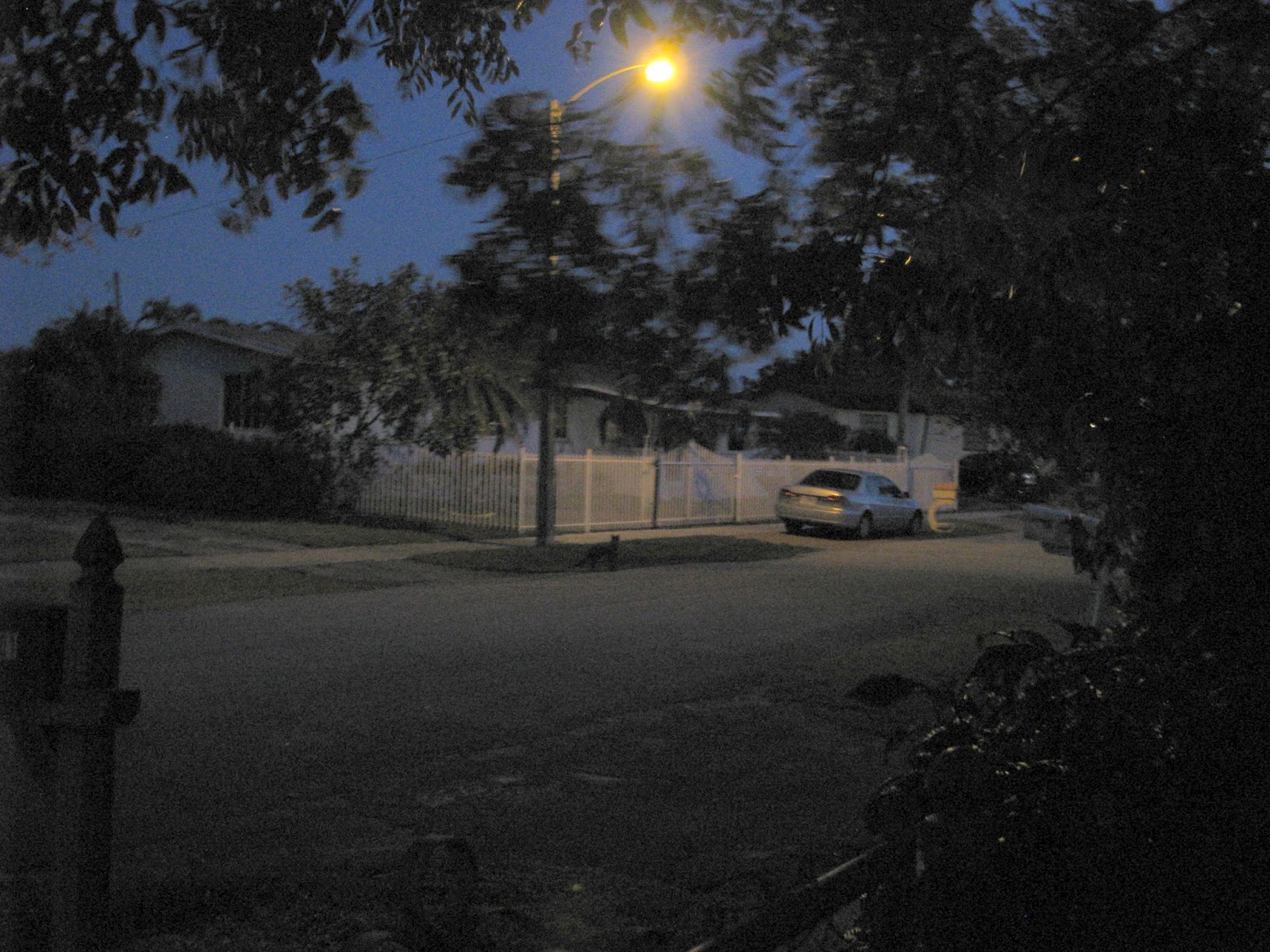
The next morning it was quiet, but when I was pulling the truck out of the driveway, there was a fox across the street in the neighbor's front yard. This fox looked like a female that was nursing kits. In the above photo the fox is right under the street light.


The photo above is the fox in my yard, maybe 30 ft. from my back door. Our native foxes are gray foxes Urocyon cinereoargenteus, they are omnivores eating insects, fruits, and small game. The are good ratters and if there are rats around they will go after them. They are able to climb trees and will go into palm trees after rats. They weigh from 7 - 13 lbs. and the males are larger 
and have bushier tails. 
  A sad note about the foxes, now that coyotes are here, they will kill foxes when the coyotes move into an area, as the fox are competition for small game. The same reason they kill cats and dogs. Canis latrans, the coyote is so far just along the coast. Last weekend I watched one cross the turnpike in front of me south of Homestead. They are in Everglades National Park, and in the natural areas going up the coast to Coral Gables, Matheson Hammock, etc. They hamstring the animal first and then when it can't run or walk anymore they kill it. 

This is a male fox that was killed by coyotes. You can see the colors of the fox and full fluffy tail. White spots on shoulder are bite marks.


    For some years I have kept hens for eggs. I usually have three or four, never more, and absolutely no roosters. To answer your question, no, you do not need a rooster for hens to lay eggs. Once they get old enough, and you feed them right they will produce eggs. I let my hens out into the yard in the evening to graze, eat bugs, and dust bathe under the bushes. Now with the fox possibly in the yard I have to keep an eye on them when they are loose.


    Some time ago I had an ambitious young possum, about the size of a ten week old kitten, hanging around that I had to haul out of the chicken house several times, though not daily. As it seemed to have a learning curve I trapped it and released it into the hammock at work. A couple times it was in the house when the hens were going to go to roost. In this case the hens come to the patio to try to get my attention. They love to line up at the sliding glass door and look in. 
   On the chicken house I have a wonderful solar powered automatic chicken house door https://www.chickendoors.com/ it opens in the morning and closes in the evening at whatever times I set it at.  Sometimes they go to bed and the door doesn't shut for a while due to the time setting. So they are on the roost, having come back in the pen from the backyard with both the pen gate is open and their house door open and the possum comes in. I have been lucky that I have shown up before the possum grabs anyone. I have had neighborhood cats also try to kill the hens or come in my yard and stalk them. My cats respond by loud piercing meows which catches my attention. 


*Zebra longwing, Julia, Black Swallowtail, Giant Swallowtail, Sulfurs, & Gulf fritillary

Wednesday, October 19, 2016

Kissimmee Prairie Preserve State Park, the 12 hour tour.

    I recently found out about a wildflower walk with Roger Hammer and Craig Huegel to benefit the Friends of Kissimmee Prairie Preserve State Park. This sounded interesting so I signed up for the afternoon walk, I knew I couldn't get up there in time for the morning walk. They also offered a swamp buggy ride so I signed up for that too.  For some reason, I never even considered camping out there the night before to make the early walk. Probably my aversion to heading out into Friday rush hour traffic to begin a weekend.
 Google maps routed me up US 27 and around the east side of Lake Okeechobee and estimated almost three hours to get to the park. Checking mileage afterward, I found that the route west of the Lake is actually longer.


 After leaving US27 at Okeetanta onto a two lane side road, I drove through Belle Glade, Pahokee, and Canal Point. Thinking all along, if this dike/levee fails these are the people who will lose their homes. There are houses with the levee seemingly right at their back yards. I passed Port Mayaca and Up the Grove Beach. As I was rushing to make it to the park by 1:15 p.m. to catch the wildflower walk I could not stop and take photos. At Port Mayaca, the Kanner Highway heads off to the east and 98 passes over the exit and you can actually see the vast expanse of Lake Okeechobee from this overpass. I left 98 at Up the Grove Beach and crossed over to 710 to pass through the city of Okeechobee.  Catching 98 again to head to Basinger, near the Florida Trail.
 There the terrain changed, it looks somewhat like it does along US 27 south of Fisheating creek but not so many oak hammocks. Running to the horizon is grass, beef cattle, and tall sabal palms in clumps.   I pass the entrance to Dixie Ranch 'since 1918' it says on the sign. I found that hard to imagine living on a ranch, probably four or five generations raising cattle in Florida.                 


     With all the small towns and slow speed limit zones I passed through, I knew it would take me every bit of three hours to get there. The instructions indicated I would have to drive the final five miles on a dirt road with a 25 mph speed limit due to wildlife. The park entrance day fee is four dollars and I followed the directions and put it in the 'iron ranger'. I passed more cows and a couple of donkeys heading into the park. Here in the park, the vegetation changed, the grasses are taller and in colored bands seeming to parallel the road. I found it hard to imagine having to travel across this either on foot or horseback as the natives and pioneers did.

As I got near the park office I saw this Crested Caracara with a couple of Black vultures on the road, the Caracara was scratching in the roadside dirt like a chicken trying to find something. I was running late but I had to try to get a shot.  The tour group was leaving as I got there, but the organizers  insisted I had to go as I had come so far, and we got in a truck and caught up with the tour before they went off-road. I got a spot on a hay bale up in the bed of the pickup that was pulling the trailer where everyone else was riding sitting on hay bales. From this position I had a higher vantage point to see that the fields were full of flowers.


 The road taken for the tour is called the Audubon trail, currently  wet, muddy and in some places a flooded track.  Eastern meadowlarks flushed as we passed and I saw a snake's tail as it was washed away from the truck passing through the water. We all climbed out and Roger and Craig started pointing out plants and flowers. Immediately we saw the pine lilies,
Pine lily
 a white rose gentian, Sabatia brevifolia, Liatris species, Florida paintbrush, and more. 

Sabatia brevifolia Shortleafed rose gentian
Lobelia glandulosa Glade Lobelia

Liatris sp.
Polygala rugelii Yellow milkwort
 Polygala, Milkworts were everywhere, KPPSP lists 8 species of Polygala, I think I saw four.  

Vanilla leaf
Vanilla leaf Carpheforus odoratissimus var. subtropicanus


This was our second stop along the trail, the Vanilla leaf plants, this plant really smells like vanilla. They were scattered all among the saw palmetto here. Dark splashes of purple amongst the green.
The park provides a plant list and a butterfly list for visitors. The KPPSP has nearly 54,000 acres with 100 miles of trails for hiking, backpacking (there are only two remote backpack campsites) and horseback riding (camping facilities with paddocks) it looks like there will be more to explore on my next trip.

Tuesday, August 2, 2016

A July walk through Archbold Biological Station

    I've been to Archbold Biological Station a few times, I had heard of it many years ago, and it sounded fascinating. A place where researchers can study plants, animals, and any number of other things in that particular habitat. The Organization of Field Stations website does a much better job describing what Biological Field Stations do*. Archbold comprises over 5,000 acres of Lake Wales scrub habitat for researchers to study. One of my favorite research results is that they have found after decades of research and data collection is that the saw palmetto, Serenoa repens are thousands of years old. After measuring their growth for decades and then recently doing DNA testing they were able to track their trunks back to their center of growth and realized some of these palms are 6 to 8 thousand years old. In a previous blog, I mentioned that the Florida rosemary is also thought to be hundreds of years old. Now just think how much of this ancient Florida scrub has been plowed over to provide us with Fresh from Florida orange juice, or more residential sprawl. Here is a link to a movie produced by Archbold explaining what they do Archbold Biological Station 

Here are some photos from my visit;

Right inside the entrance, an area that doesn't get burned.
 Scrub habitat that has recently been burned.

Look at all the Zamia 'Coontie', no wonder Atala butterflies lay so many eggs.

Another shot of this area, almost all of the green is Zamia 'Coontie' plants.

Grasshopper?

Because of the sand, animal and insect tracks are easily seen, it had rained the night before so any tracks showing were pretty recent. 

Bobcat, going both ways.

Tire tracks are from a researcher traveling the area on an ATV.

Followed this one for a while, pretty definite trail.


Armadillo


coyote tracks


The diversity of plants and animals in a place that appears so harsh an environment is amazing. Here are some of the birds, plants, flowers and lichens that live here.

The Florida Scrub Jay, an endemic species, only occurring in scrub areas.

 
Commelina erecta'Day flower'

Scrub oak with acorns.
Scrub Pawpaw with fruit Asimina obvata
I'll just call it a Skink, there are five species here.
The last half of the trail where the public is allowed has branches and trees down and is overgrown. It looks as though no one has been through there lately.

The one area near water, is now under water, with waist-high plants covering the trail.  If walking through areas like this bothers you, then wait until winter when it should be easier walking.


Here's a couple of cute little Earthstars, Geastrum sp. up by the Visitor Center. They are related to Puffball mushrooms.
Earthstars

I hope you enjoyed the tour!


* http://www.obfs.org/what-s-a-field-station-

Monday, August 1, 2016

A visit to the Lake Wales scrub

   Recently I headed up US 27 for a little woods time, this time in the Lake Wales scrub. As I was headed up for the Caladium Festival in Lake Placid the same weekend this worked out perfectly. I could visit Archbold Biological Station and then found out about a volunteer opportunity in the area that would allow me to see other scrub areas I wouldn't have seen otherwise. So I signed up to volunteer with the Ridge Rangers in their final planting of the year.
   These volunteers work with Florida Fish and Wildlife Commission on FWC properties. They are trying to restore some property the state recently purchased, seeking to connect more dots of wilderness for a wildlife corridor. The Ridge Rangers volunteers had collected acorns from scrub oaks*, grown them out, weeded the pots, and now they were ready for planting out in the scrub. The sand in the area is really deep and even one of the four wheel drive trucks had gotten stuck up to the axles. It was one of the water trucks with a full tank and pump on board to water the plants in. Luckily, it was stuck where it could be unloaded to water the plants. This is really a production very well organized with these volunteers.

    We passed through this area (below) on our way out to the scrub area.
This is called a "cut throat" seep.


I am continually amazed by the phone, these are phone photos taken from a moving UTV rolling along at a good pace, much faster than I've traveled through Big Cypress Preserve on a swamp buggy. Negotiating this sand with vehicles is a tricky deal. Rather like riding a rolling surf.


Below is the type of area we were planting in, there are some invasive grasses that hopefully the new oaks will shade out and allow more natives to come back in. There are oaks, rosemary clumps, saw  palmetto, Opuntia cactus, and Smilax to trip us up. Only one tortoise burrow in this area that I saw. This is high ground northeast of Lake Istokpoga. With few clouds, and a  bright July sun we were very happy to have some breeze out there as temps were up in the 90° range.


  Florida  rosemary Ceratiola ericoides. This is one of the smaller rosemary plants. These plants can be hundreds of years old, they get burned down in fires from lightning, and then re-grow. The Florida rosemary plants are allelopathic, meaning that they will not allow other plants to live near them, so we had to be sure to not plants any of our little oaks near them. Plants can be considered allelopathic by using  chemicals to repel or kill other plants, or sometimes by just being a more efficient consumer of the nutrients in the soil, or by shading out other plants. As an example turf is allelopathic to trees, as it can grow six times faster than the tree, consuming water and nutrients before they can get to the trees roots.


Here's the crew packing up the canopy,  water hoses, and tools. Even where the canopy stood will be planted with oaks. So as we leave plants are still going into the ground, given water and good wishes so they too can live hundreds of years in this amazing habitat.


*Scrub oaks can be Quercus myrtifolia, or Q. inopina, Sand live oak Q. geminata, or Chapmans oak Q.chapmanii.  Source US Fish & Wildlife Service

Update: The Ridge Rangers volunteers planted 1,415 scrub oaks over this summer.